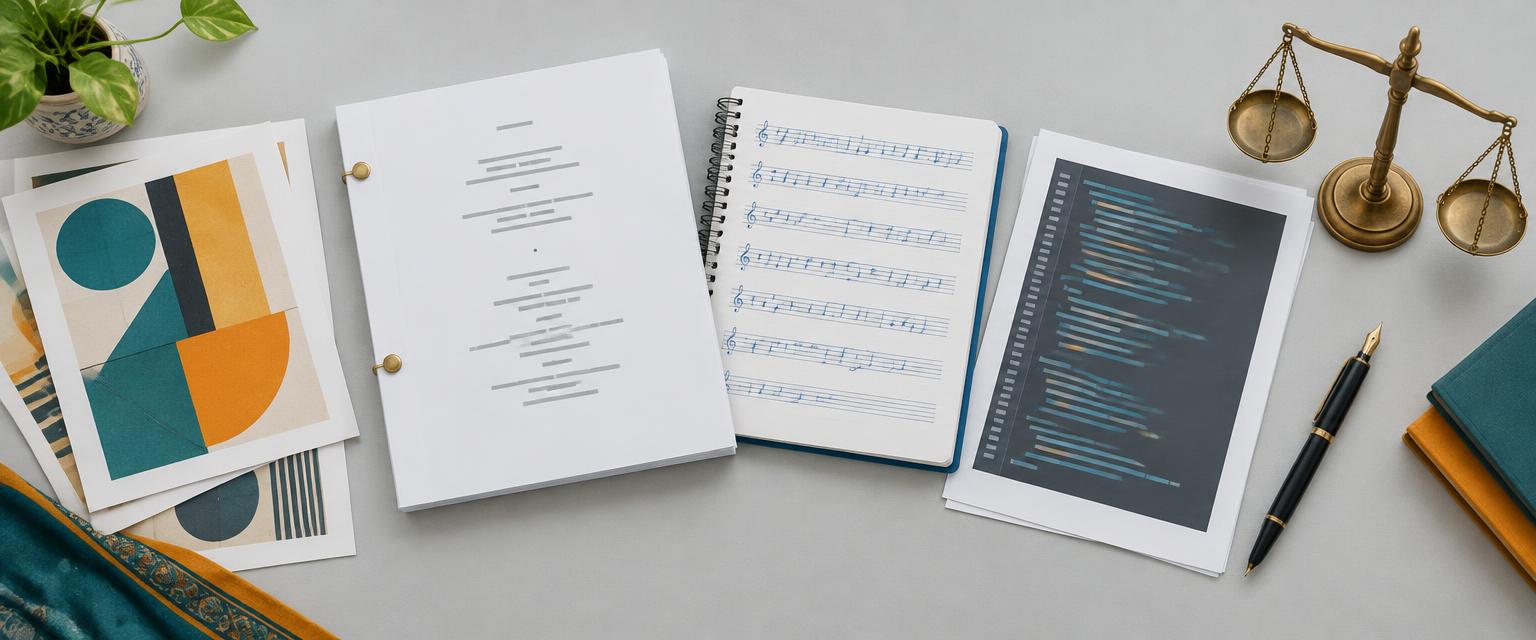
Scripts, music notes, software records and artwork alongside legal scales

N1X Copyright Evidence Bureau · Case Studies

Real copyright disputes.
Lasting lessons for creators.

A script, a melody, a codebase, a design. Real judgments show why the exact work, its development and its disclosure history matter.

Explore the judgments

The exact expression

Preserve what you created—not only the idea.

The development trail

Keep drafts, versions and disclosure records.

The court’s assessment

Chronology supports evidence; legal tests still apply.

The case library

What actually happened—and what to preserve

These are real judgments, not N1X customer success stories. Each separates the court’s decision from a practical lesson in preserving evidence. The Indian precedent applies in its jurisdiction; the UK and EU decisions offer comparative lessons, not Indian statutory rules.

4 judgments

Scripts & stories · Supreme Court of India

R.G. Anand v. Delux Films

(1978) 4 SCC 118 · AIR 1978 SC 1613 · 18 August 1978

Does sharing the same story idea establish copying?

The dispute

Playwright R.G. Anand alleged that the film New Delhi copied his play Hum Hindustani. He had discussed the play with the filmmaker. Both works explored provincialism and opposition to an inter-community marriage.

What the court decided

The Supreme Court dismissed the appeal. Copyright protects the form and expression of a work, not an idea, theme or subject by itself. The Court’s comparison did not establish substantial copying of the play’s protected expression.

The timestamping lesson

Record the complete script version before a pitch, not just a synopsis of the idea. A dated deposit can help identify the exact expression that existed before disclosure; pitch emails and delivery records help establish who received it. A timestamp does not confer ownership over a shared theme.

What to preserve before sharing

  • Full screenplay and successive drafts
  • Pitch deck and treatment as separate versions
  • Submission emails and delivery records
  • Written collaboration and assignment agreements
Judgment & source

The judgment establishes the legal principle. The preservation advice above is N1X’s practical application, not a claim that N1X was used in this case.

Read the original judgment

Music & audio · High Court of England and Wales

Sheeran v. Chokri

[2022] EWHC 827 (Ch) · 6 April 2022

How can a songwriter demonstrate independent development?

The dispute

The writers and publishers of Shape of You sought a declaration of non-infringement after allegations that its ‘Oh I’ phrase copied the ‘Oh Why’ hook in an earlier song. The defendants counterclaimed for infringement.

What the court decided

The Court found neither deliberate nor subconscious copying, granted the declarations and dismissed the counterclaim. It examined musical features, alleged access to the earlier song, voice notes and evidence of the songwriting sessions—not simply the date on a final recording.

The timestamping lesson

Preserve the creative journey: voice notes, demos, stems and session exports. Recording successive versions creates a chronology that can support an independent-creation account. A timestamp on a finished track alone cannot explain how it was composed.

What to preserve before sharing

  • Early voice notes and acoustic demos
  • DAW projects and dated session exports
  • Individual stems and lyric revisions
  • Songwriting credits and session records
Judgment & source

The judgment establishes the legal principle. The preservation advice above is N1X’s practical application, not a claim that N1X was used in this case.

Read the original judgment

Software · Court of Justice of the European Union

SAS Institute v. World Programming

C-406/10 · ECLI:EU:C:2012:259 · 2 May 2012

Is reproducing a software feature the same as copying code?

The dispute

World Programming developed software that reproduced relevant SAS functionality and ran programs written in the SAS language. It studied manuals and licensed software; the reference proceeded on the basis that it had no access to SAS source code.

What the court decided

In a preliminary ruling, the CJEU held that functionality, programming languages and relevant data-file formats were not protected as the expression of a computer program under the applicable directive. Copying protected code or original manual text remained a different question. This ruling was not the final disposition of every claim between the parties.

The timestamping lesson

Record source-code snapshots and development inputs at milestones. These can help distinguish an independent implementation from copied expression. A timestamp of a feature specification does not make the feature itself copyright-protected; contracts remain important for ownership and licensing.

What to preserve before sharing

  • Source-code archives at release milestones
  • Design notes and development records
  • Third-party dependency and licence records
  • Developer contracts and IP assignments
Judgment & source

The judgment establishes the legal principle. The preservation advice above is N1X’s practical application, not a claim that N1X was used in this case.

Read the original judgment

Art & design · House of Lords, United Kingdom

Designers Guild v. Russell Williams

[2000] UKHL 58 · 23 November 2000

Can a different-looking design still copy protected artwork?

The dispute

Designers Guild alleged that Russell Williams’s Marguerite fabric design copied its Ixia design. The dispute concerned artistic features involving flowers and stripes, rather than ownership of the general idea of combining those elements.

What the court decided

The House of Lords allowed the appeal and restored the trial judge’s infringement finding. The inquiry concerned the protected features taken and whether they represented a substantial part of the original work. A different overall appearance did not necessarily resolve that inquiry.

The timestamping lesson

Keep sketches, layered artwork and intermediate versions, along with disclosure and publication records. They help connect the final design to its development history. The court must still assess what was copied and whether that copying concerns a substantial part of protected expression.

What to preserve before sharing

  • Original sketches and layered design files
  • Intermediate compositions and final exports
  • Client approvals and delivery emails
  • Publication records and licence agreements
Judgment & source

The judgment establishes the legal principle. The preservation advice above is N1X’s practical application, not a claim that N1X was used in this case.

Read the original judgment

Why timestamp before sharing?

Build the record while the work is being made

Evidence preservation with local files and N1X records
Evidence questionLocal files aloneWith a verifiable N1X record
Which version existed?A filename or editable file date needs supporting context.A SHA-256 fingerprint identifies the recorded file’s exact bytes.
When was it recorded?Device timestamps can be changed or disputed.The signed receipt links the fingerprint to the bureau’s recorded time.
Has the file changed?A later export may differ from the submitted version.A matching fingerprint checks whether the presented bytes match the deposit.
What was shared?Emails and client records may be scattered.Keep disclosure records alongside receipts for each submitted version.
Who owns the rights?Ownership depends on authorship, contracts and applicable law.Retain those records too; a receipt documents a file, not a transfer of rights.

Automatic protection. Deliberate preservation.

Article 5(2) of the Berne Convention provides that enjoyment and exercise of copyright shall not be subject to formalities. Timestamping is not a condition of copyright protection: its role is to preserve an identifiable, dated record of a work.

Read the Berne Convention at WIPO

Prepare the evidence for Indian proceedings

Sections 61–63 of the Bharatiya Sakshya Adhiniyam, 2023 address electronic records. Preserve originals and the connected receipt, integrity checks and disclosure history. The N1X court dossier assembles technical details and custodian/expert completion fields; the applicable statutory certificate must be completed and signed as required for the submission.

Explore the Legal & Court Portal

Preserve your next milestone

Make your evidence part of your creative process.

Record the draft before the pitch, the demo before release and the code before delivery. Keep agreements and correspondence alongside your version history.

N1X Copyright Evidence Bureau · A unit of N1X Tech Services Organisation · GSTIN 32COBPM9612R1ZH